Two sellers put about $8,000 into Amazon this month. One spent it on 500 units of a product nobody has bought before, with his own brand printed on the box. The other spent it on cases of a brand shoppers already search for by name. Same platform, same 15% referral fee in most categories, same FBA warehouse, same $39.99 monthly plan. Two completely different businesses. One is betting that a product he invented will sell. The other is betting he can win the Buy Box on a page he does not control. Most beginners choose between these by reading a comparison table, and that is the wrong way to choose.
01These are two different jobs, not two versions of the same job
Private label means you create the product and the listing. You find a manufacturer, put your brand on their product, get a new ASIN, and you are the only seller on it. Nobody else can list against you unless they hijack you, and if they do, you have grounds to remove them. The page is yours. The images are yours. The price is yours.
Wholesale means you buy branded products from the brand owner or an authorized distributor and resell them on Amazon. You do not create a listing. You join one that already exists, usually alongside other sellers doing the same thing, and you rotate through the Buy Box based on price, seller metrics, and stock. The brand owns the page. You own the inventory sitting in it.
That distinction sounds small on a comparison chart. It is the whole thing.
Here is what each model is actually asking you to be good at:
- Private label asks you to be right about a product. You are guessing what a stranger wants, betting money on that guess months before you get an answer, and living with the answer for a year.
- Wholesale asks you to be good at buying. Finding brands that will approve you, negotiating terms, reading which SKUs move, and re-ordering fast enough to keep the cash turning.
- Private label pays you for judgment. If your product choice and differentiation are right, the margin is yours to keep because nobody else sells that exact thing.
- Wholesale pays you for operations. The product is proven, the demand is proven, and your edge is buying it cheaper and moving it faster than the seller next to you on the same page.
We currently run Amazon stores doing $200k/month for paying clients, and every one of those accounts is private label. That is a choice, not a verdict, and I will explain the reasoning rather than pretend the other model does not work.
02What private label costs to start, using a real launch
I can give you the private label number precisely because it is ours. One client launch we ran, a vegetable chopper in Home and Kitchen, cost $8,450 in cash before a single organic sale came in.
The breakdown looked like this:
- Samples: about $150 per supplier. We ship samples to Pakistan rather than the US, because Pakistan is closer to China. Samples land in roughly a week and the shipping per sample is a lot cheaper. We check them in hand before anyone places a production order.
- First production order: $4,500 for 500 units, landed DDP. That is $9 a unit delivered, handled through our own shipping company, Freightklan. DDP means duty and delivery were inside that number, so there was no surprise bill at the port.
- Photography and listing content: about $800. That was a photographer plus a separate content person who built the gallery images, A+ Content, and brand story. Today an AI assisted version of that same workflow lands closer to $200 to $400 if you brief it properly.
- Launch advertising: about $3,000, at $50 a day. Roughly 60 days of paid traffic. We have found $50 a day is the floor for a launch. Below that you do not generate enough impression volume for Amazon’s algorithm to treat the listing as worth ranking.
If you want the full version of that math across other launches, we broke it down in the real client launch cost breakdown.
Wholesale removes several of those lines. You are not paying for samples of a product that may not work. You are not paying a photographer, because the listing already has images. You are not funding a 60 day ranking ramp, because the ASIN already ranks. Your money goes almost entirely into inventory.
What wholesale adds instead is paperwork and permission. You need a resale certificate and a registered business before most brands will open an account. You need brand approval to sell many catalogues at all. And you need enough cash to keep re-buying, because a wholesale business is not one order that lasts a year, it is a cycle you feed every few weeks.
I am not going to publish a tidy “wholesale costs $X to start” figure. We do not run wholesale accounts for clients, so I have no measured number of my own, and the honest answer is that it swings entirely on which brands approve you and what their minimums are. Anyone quoting you a precise wholesale startup cost is quoting a guess.
03The Amazon fees are identical. The margin is not.
Here is the part that surprises people. On the same $30 product, a private label seller and a wholesale seller pay Amazon exactly the same. The same 15% referral fee in most categories. The same FBA fulfillment fee based on size and weight. The same monthly storage. Amazon does not care how you got the box.
So the margin difference has nothing to do with Amazon. It comes from two places: what you paid for the unit, and how much control you have over the price it sells at.
Private label buys at a factory price. That vegetable chopper landed at $9 a unit including freight and duty, and it sold in the high twenties. There is no brand and no distributor taking a cut in between, because you are the brand.
Wholesale buys at a wholesale price, which by definition is set to leave room for the brand and the distributor to make money first. You are third in that line. That is not a flaw in wholesale, it is what wholesale is.
We hold private label to a hard number: net margin of 30% or more after every cost, or we do not move forward. Not 20%. Not 15%. Those are a red light and we go back to product research. Running it is straightforward:
- Open Amazon’s own FBA Revenue Calculator.
- Enter the real packed dimensions and weight from your supplier, not an estimate. Fees are calculated on size and weight, so a guess here makes every number downstream wrong.
- Enter your target sale price based on what competitors actually charge.
- Enter your landed cost of goods.
- Read the net margin at the bottom. Above 30% is a green light. Below it, the product is not the problem to solve, it is the product to drop.
A thinner margin can still work in wholesale, and this is where the comparison gets genuinely interesting. Margin percentage is not the only thing that pays you. Cash velocity does too. A wholesale SKU you buy, sell, and re-buy every three weeks at a slim margin can return more in a year than a private label SKU at 30% that ties your money up for four months. The trade is that you have to keep working the buying side forever to hold that speed.
04What private label actually demands before you spend anything
The private label model itself is only four phases, and it is worth seeing how simple the shape is before we get to the hard part.

- Product research. Find something with existing demand that clears your revenue and margin criteria.
- Sourcing and manufacturing. Find a manufacturer, order samples, then place the production order.
- Shipping to Amazon. Send inventory from the factory into Amazon’s fulfillment centers, ideally direct.
- Selling and optimizing. Launch, advertise, fix the listing based on data, and keep going.
Four phases, and roughly 80% of the outcome is decided in phase one. This is the part beginners rush and operators slow down.
These are the filters we apply before a client’s money moves:
- Average star rating of the top sellers is 4.5 or higher.
- Most of the sellers on page one are FBA, not FBM.
- No Amazon dominance and no single brand dominance. If more than 3 of the top 10 come from the same brand, the market is controlled and a new seller is not getting in.
- Average reviews on page one under 600.
- At least 40 sellers holding under 200 reviews each are still making $10,000 a month or more. That is our proof that a new entrant can compete.
- Fewer than 3 variations on the product, so you are not fragmenting your reviews across a dozen SKUs.
- Average sale price of at least $25, so there is room for fees and advertising and still a profit.
- Advertising cost per click under $1.50 on the main keywords.
- Year round demand. We check sales history and search trends and drop anything with big seasonal spikes and dips.
And the one that matters most: there has to be a clear way to stand out. Better packaging, a bundle, or a product improvement pulled from the complaints in competitor reviews. If you cannot answer “why would someone pick mine” before you source, you do not have a private label product. You have a wholesale product with extra steps and none of the safety. The full sequence sits in our 9-step product research process.
Two launches show what those filters buy you when they are applied properly.
The first was a relaunch for the same client whose vegetable chopper failed. We ran the checklist honestly the second time, in a mid retail Home and Kitchen category. It came in at 30% net margin with a 15% ACoS in month one. For context, plenty of beginner launches open at 50% to 80% ACoS and grind downward for months.
The second was a sports and fitness product for another client. Same crowded setup the wood therapy tool faced, with several competitors selling a similar core item. What changed was the offer. We bundled it with a hand band, a wrist band, a resistance band, and a small carrying bag, then put all four items in the main image instead of burying them in the title and bullets. We also priced it 20% above the category average rather than matching everyone else.
It held page one from launch onward. Month one came in at 25% ACoS and 13% TACoS, profitable inside the first 30 days while charging a premium. Click through and conversion both ran above category average, because a shopper scanning results saw four items in our thumbnail and one item in every competitor thumbnail.
That is the private label edge in a single example, and it is worth reading against the wholesale model directly. Nobody could copy that bundle onto our page, because it was our page. A wholesale seller cannot run that play at all. You cannot bundle, price above the market, or change the main image on a listing somebody else owns.
Wholesale skips almost all of this. Demand is already proven, the reviews already exist, and the listing already ranks. That is the genuine advantage of the model and it is a real one. What you are choosing instead is a permanent competitor problem, which is the next section.
05How each model actually fails
I would rather show you two of our own launches that did not work than list theoretical risks.
The first was a client’s wood therapy massage tool. Generic product, several competitors selling the identical physical item. We managed it for 12 months. Every tactic we ran lifted sales for two to four weeks and then they slid back. PPC keyword targeting, ASIN targeting on competitor pages where their photography was weaker than ours, listing rewrites, image refreshes. All of it worked briefly. None of it compounded, because when products are interchangeable, buyers pick the cheapest one. We were winning the visual fight and losing the wallet fight. The competitor $3 below us won.
The line I gave that client still holds: we can be the best at running a generic product, and that does not make a generic product worth running. Differentiation has to be built in before you source. You cannot bolt it on afterwards. If you want the specific plays, we wrote them up in how to differentiate a saturated niche.
The second failure was that vegetable chopper. We differentiated it properly with a cut resistant glove, a manual, and gift quality packaging. It ranked. Revenue came in. ACoS was healthy. It still failed, slowly, over months four through twelve, because returns kept eating the margin. The signal we missed sat in plain sight before launch: the top sellers in that niche averaged below 4.5 stars. That is a category signal, not a seller signal. The product type disappoints a slice of buyers no matter who sells it, and you inherit that the moment you enter. Ad metrics looked fine the whole way down. The bank account told the truth.
Now look at what those two failures have in common, because it explains wholesale better than any pros and cons list.
Both died from being interchangeable. And on a shared wholesale ASIN, interchangeable is not a mistake you made, it is the permanent condition of the model. Every seller on that page has the identical product, the identical images, and the identical bullets. Price and stock are the only levers you hold.
That is survivable, and plenty of wholesale sellers do well with it, but you have to want that game. The other wholesale risks follow from the same root:
- The brand gates its catalogue, or tightens who it approves, and your supply stops.
- The brand starts selling direct or goes first party with Amazon, and you are now competing with the manufacturer on their own product.
- Another seller drops price to move stale stock and drags the Buy Box price under your cost.
- The listing gets changed, suppressed, or hit with an IP complaint by someone else, and your inventory is stranded on a page you have no control over.
The private label version of that last risk does not exist, because it is your listing. The private label version of the first risk does not exist either, because it is your brand. What you pay for that control is the $8,450 and the 90 day wait.
06Which path suits which person
Stop asking which model is better. It is the wrong question and it produces a useless answer. Ask which one fits the money, the patience, and the temperament you actually have.
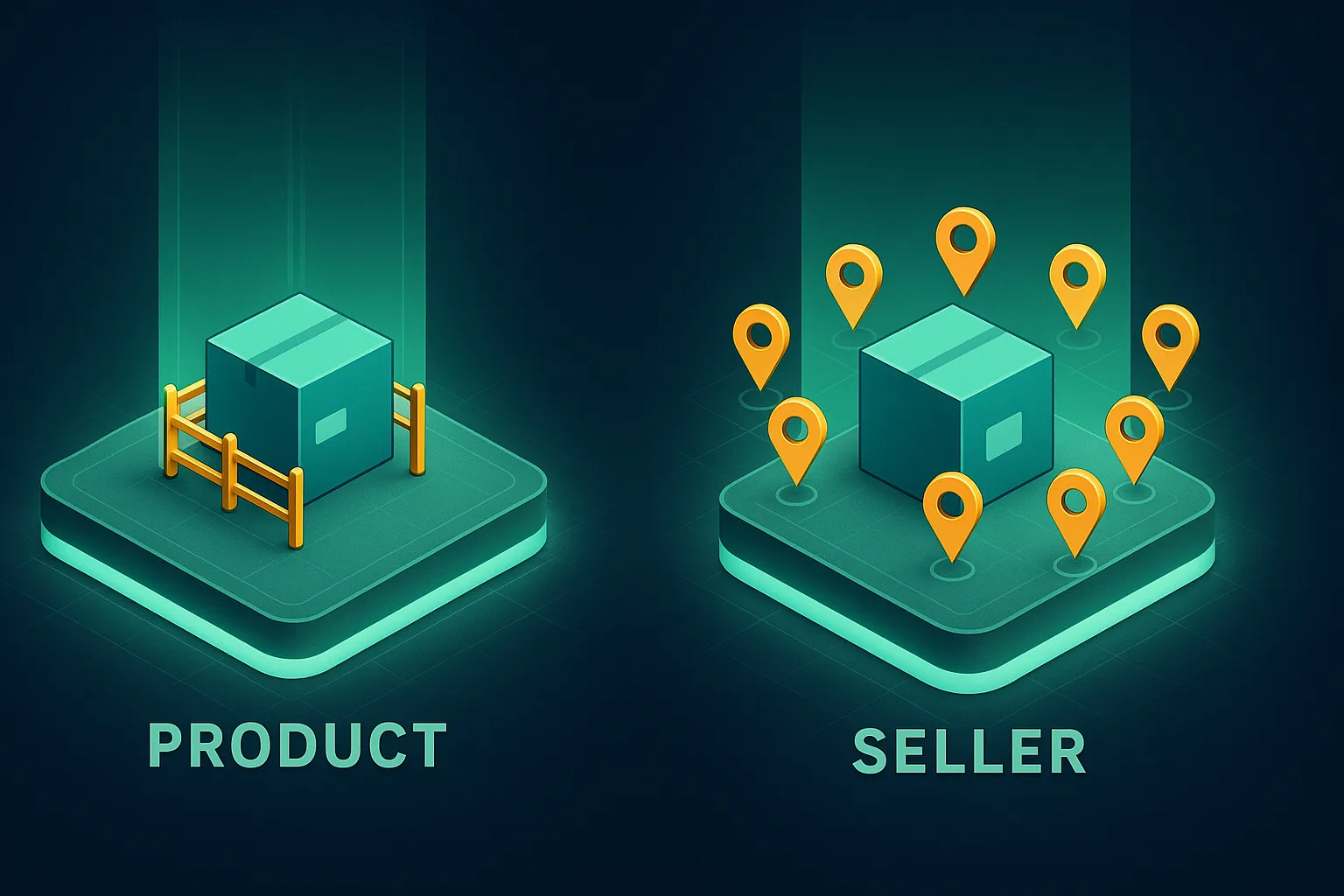
| Private label | Wholesale | |
|---|---|---|
| What you buy | A product you design with a factory | Branded stock from a brand or distributor |
| Who owns the listing | You | The brand |
| Competitors on your page | None, unless hijacked | Everyone selling the same brand |
| Where margin comes from | Factory pricing and differentiation | Buying well and turning stock fast |
| Our target margin | 30% net minimum | Thinner by design, made up in velocity |
| Upfront cash | Around $5,000 to $9,000 realistically | Inventory plus accounts, and it recycles |
| Time to first sale | 60 to 120 days | Weeks, once accounts are open |
| Main risk | You picked the wrong product | You lose the Buy Box, or the brand cuts you off |
| What you own after 2 years | A brand and an asset you can sell | A buying operation and supplier relationships |
Wholesale probably suits you if you enjoy negotiating, you want revenue sooner rather than later, you have capital that needs to keep cycling instead of sitting in one bet, and you are not attached to building a brand of your own. Ex retail and distribution people tend to take to it fast, because it is the job they already know with a different storefront.
Private label probably suits you if you can put $5,000 to $9,000 in and leave it there for three months without panicking, you can wait 60 to 90 days for real feedback, and you already have an idea of how your version would be visibly better than what is on page one today. That last condition is the one people skip, and skipping it is what produced both failures above.
If neither description sounds like you, that is worth listening to. The most expensive Amazon decision is not choosing the wrong model. It is choosing one and quitting at month five with inventory in a warehouse.
07When it makes sense to bring in help
We run private label. The checklist above, the shipping company, and the launch process were all built around that model, so that is the honest scope of what we do. If you have decided on wholesale, we are not the right team, and you are better served by someone who lives in brand approvals and distributor terms every day.
For private label, the phase worth paying for is phase one, because it is where the $8,450 gets committed and where both of the failures above were decided. Our Product Research service runs that phase end to end: the criteria above applied to real niches, supplier vetting, a Freightklan shipping quote so the landed cost is a real number rather than an estimate, a competitor audit, a listing outline, and a PPC seed list. It is $1,500, and it exists because filtering is cheap and inventory is not.
If you would rather run it yourself, run it yourself. Just run the filters before you spend, not after.
Frequently Asked Questions
Is private label or wholesale better for beginners on Amazon?
Neither is beginner friendly in the way people hope. Wholesale gets you to a first sale faster because demand and ranking already exist, but it needs business paperwork, brand approvals, and cash that keeps cycling. Private label needs more money upfront and 60 to 90 days of patience, and it gives you something you own at the end. Pick based on your cash and your patience, not on which one sounds easier.
How much money do you need to start Amazon private label vs wholesale?
Our own launches have landed around $8,450 all in, covering samples, a 500 unit first order, photography, and a 60 day advertising ramp. A realistic private label range is $5,000 to $9,000. For wholesale, the honest answer is that it depends entirely on which brands approve you and what their minimum orders are. We do not run wholesale accounts, so I will not invent a figure for it.
Do you need a trademark and Brand Registry for wholesale?
No. You are selling someone else’s brand, so their trademark protects that listing, not you. Private label is the opposite. You file a USPTO trademark, which is $250 when you pick the right class first time, and you can apply for Amazon Brand Registry while the trademark is still pending rather than waiting months for approval. Brand Registry needs real photographs of your branded packaging or product, not AI renders or mockups. Amazon’s reviewers reject mockups.
Which has better margins, private label or wholesale?
Private label carries the higher margin percentage because you buy at a factory price with nobody in between. We hold clients to 30% net or we drop the product. Wholesale margins are structurally thinner because a wholesale price is set to pay the brand and the distributor before it pays you. Wholesale makes that back on speed, since the same money can turn several times a year instead of sitting in one product for four months.
Can you run private label and wholesale at the same time?
You can, and some sellers use wholesale cash flow to fund private label bets. Just be honest that they need different skills on different days. Wholesale is a buying and re-ordering rhythm you work weekly. Private label is a research and launch project that goes quiet for months and then needs full attention. Beginners who try both usually do neither properly for the first year.
Do you need a UPC for private label?
Not to start. You can apply for a GTIN exemption from Amazon for free using photographs of your product or packaging with your brand physically on it, which is the route we walk first launch clients through. GS1 UPCs start around $50 and are worth checking current pricing before you buy. Wholesale sidesteps this completely, because the branded product already has its own barcode and ASIN.
The Bottom Line
Private label and wholesale are not two difficulty settings on the same game. One is a product business where you carry the risk of being wrong and keep the upside of being right. The other is a buying business where the product risk is gone and price competition is permanent. Our clients run private label, and the reason is control. When you own the listing, nobody undercuts you on your own page, and the differentiation you built is a fence rather than a feature. That control costs roughly $8,450 and a 90 day wait before you know anything. If that trade sounds fine to you, private label is your path. If it does not, wholesale is a real business and there is no shame in taking the faster, thinner, busier road.