Most “Amazon FBA blueprint” articles skip the only thing that matters: the order in which decisions get made. We’ve onboarded 47 beginner clients into Amazon launches since 2022, and the pattern is clear: the ones who ship in 90 days don’t have a secret tool, they have a forced-decision sequence. Pick a category in week 1. Validate three products in week 2. Pick a supplier in week 3. Lock the LLC in week 4. The slow ones keep “researching.” The fast ones decide and adjust later. This is the sequence we use with new clients, condensed into one read.
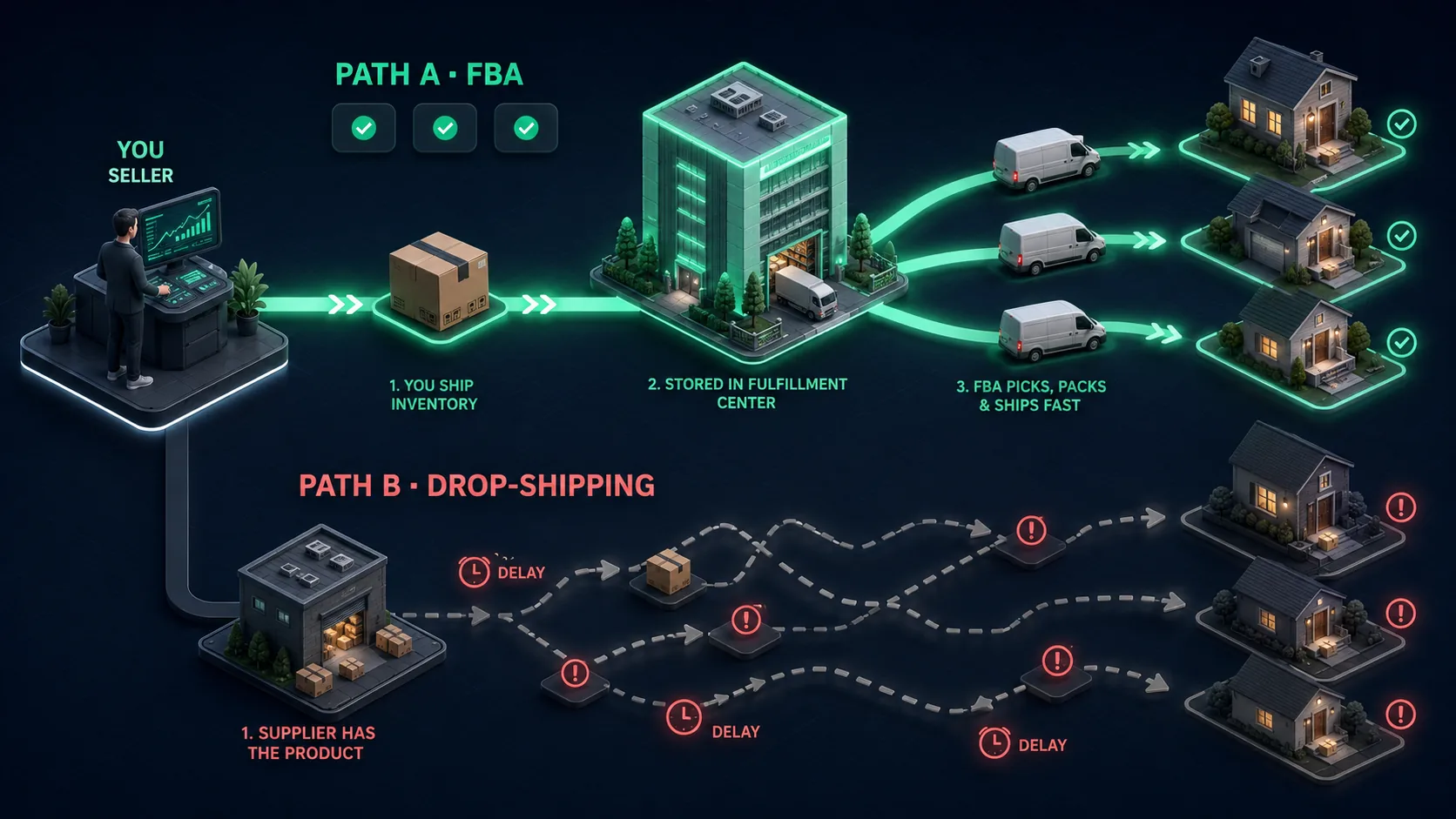
01What Amazon FBA Actually Is (and Why Sellers Confuse It With Drop-shipping)
Amazon FBA (Fulfillment by Amazon) is a service where Amazon stores your inventory in their warehouses, picks and packs orders when customers buy, ships them, and handles returns and customer service. You source your own product, ship it to Amazon, set the price, and own the brand. Amazon handles the back end.
That last part trips up almost every beginner. FBA is not drop-shipping. You buy real inventory upfront, typically 300 to 1,000 units of one product at $2 to $15 per unit landed cost, and you carry the financial risk of those units selling. Drop-shipping has zero inventory risk; FBA has full inventory risk. The trade-off is that drop-shipping’s margins are 5-15% on a good day while FBA’s margins are typically 25-40% after fees.
What you get with FBA that you don’t get with drop-shipping or FBM (Fulfillment by Merchant):
- Prime eligibility. Your listing gets the Prime badge, which lifts conversion rate 8-12% on average across our managed accounts
- Buy Box priority. Amazon’s algorithm favors FBA listings when multiple sellers compete on the same ASIN
- Hands-off fulfillment. You don’t pack a single box; Amazon does it
- Customer service handled. Returns, shipping disputes, lost packages all go to Amazon’s team
- 24/7 shipping. Orders ship Saturday and Sunday, which boosts conversion on weekend purchases
What you give up:
- Per-unit fulfillment fees ranging $3.86 to $25+ per unit depending on size tier
- Monthly storage fees ($0.87 to $2.40 per cubic foot, higher Q4)
- Long-term storage fees on inventory aged past 365 days
- Less control over packaging and inserts (Amazon’s restrictions tightened in 2024)
If you’re trying to test a $9 product with a $4 fulfillment fee, the math doesn’t work. FBA suits products in the $19-79 retail range with $4-15 landed cost. That’s 80% of what new sellers should be looking at.
02The Real Cost of Starting Amazon FBA in 2026
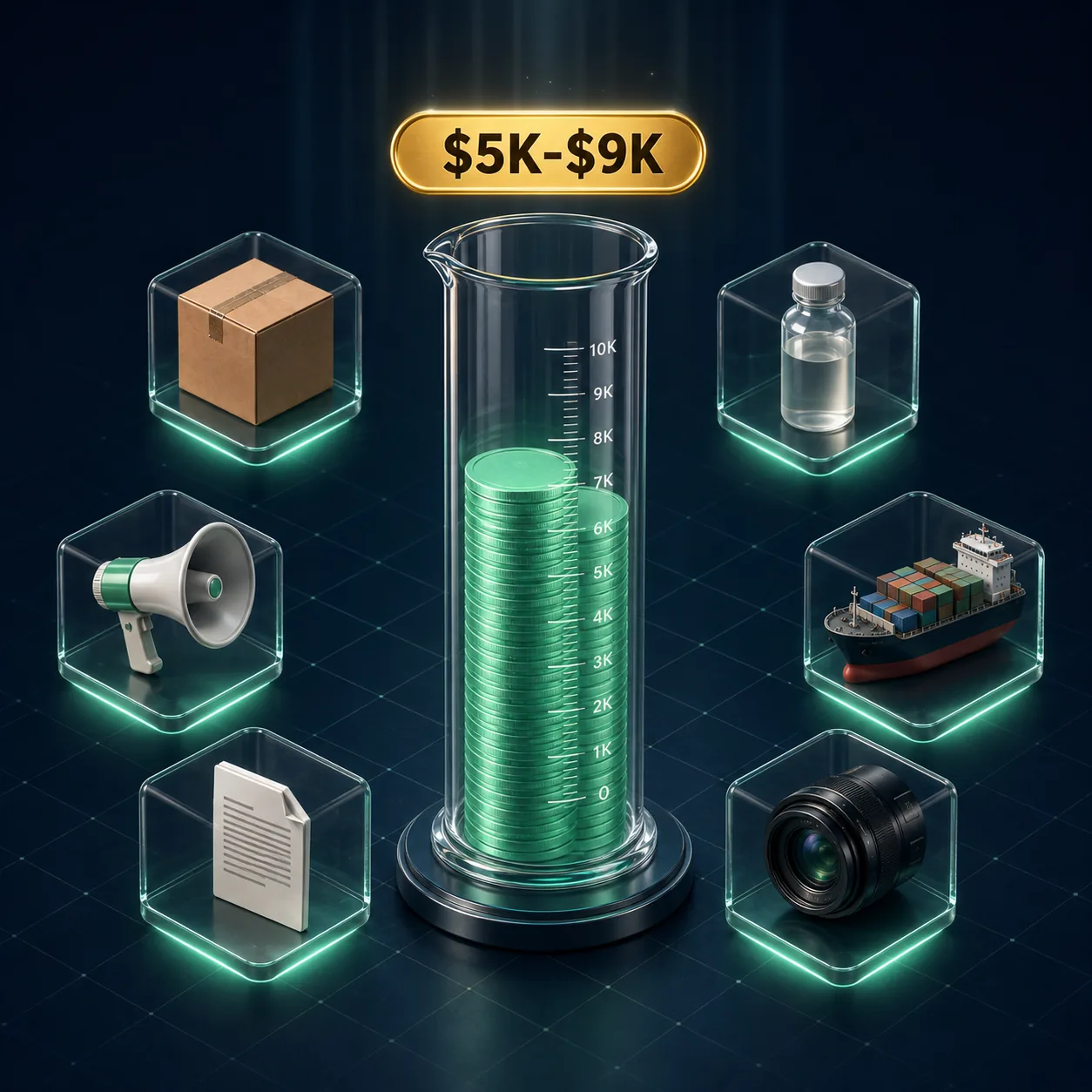
The honest budget for a single product launch in 2026, assuming you’re sourcing private label from China and shipping to Amazon’s US marketplace, breaks down like this.
Initial inventory: 500 units at $5 landed = $2,500. Smaller MOQ is possible (200-300 units) if you’re working with a flexible supplier, but you’ll pay 20-30% more per unit. Larger MOQ (1,000+) gets you better per-unit cost but ties up more cash.
Sample testing: $200-500 to evaluate 3-5 supplier samples before committing to a full order. Skipping this step is the single most expensive mistake we see. About half the suspended-listing rescues we run start with a quality issue traceable to “I didn’t sample the supplier.”
Branding and design: $100-400. Logo, packaging design, listing photography brief. A Fiverr designer at $100 works for product 1; you upgrade later.
LLC formation: $100-300 depending on your state. Wyoming, Delaware, and New Mexico are popular for low maintenance. We covered this in the course funnel module on legal setup.
UPC code: $30 (one-time, GS1) or $5-10 from a reseller. Amazon’s enforcement on GS1-only UPCs has tightened. Expect to need GS1 by 2027 or risk listing suspension. Pay the $30 once.
Trademark filing: $250-350 USPTO filing fee plus $200-500 attorney if you use one. Required for Amazon Brand Registry. Brand Registry gives you A+ Content, Sponsored Brands ads, brand defense, and brand analytics. Skipping Brand Registry costs you about 15-25% in conversion rate over a 12-month window.
Inspection service: $200-300 per inspection. Always inspect before the supplier ships out. We use a few rotating vendors; budget $250 per launch.
Shipping from China to Amazon: $400-1,200 for sea freight on 500 units depending on volume and current rates. Air freight is 3-5x more for the same load. New sellers default to air on the first launch because they’re impatient. That’s a $1,500+ mistake that buys you 4 weeks of no traction time. Plan sea, accept the wait.
Photography: $200-600 if outsourced. White background main image plus 6 lifestyle/infographic images. Amazon’s image quality bar lifted in 2024. Phone photography no longer cuts it.
PPC budget for launch: $1,000-2,500 for the first 60 days. Without PPC you don’t get launch velocity; without launch velocity Amazon’s algorithm doesn’t surface you organically. This is non-negotiable.
Tools and software: $99-300/month. Helium 10 or Jungle Scout for research, Inventory Lab or Sellerise for ops, ad management tool optional in year 1.
Total realistic year-1 cash needed: $5,000 to $9,000 for a single product launch with reasonable runway. Anyone selling you “start FBA with $500” is selling you a fantasy. The minimum where the math actually works is $5,000, and the comfortable minimum is $7,500.
About 73% of beginner sellers who fail in year 1 cite "running out of cash" as the reason, not poor product choice (Jungle Scout, 2025 State of the Seller). Underfunded launches die faster than bad products do. The single biggest predictor of survival is whether you started with $5K or $2K, not whether you picked the "right" niche.
03The 7 Decisions That Determine Whether You Ship in 90 Days or 9 Months
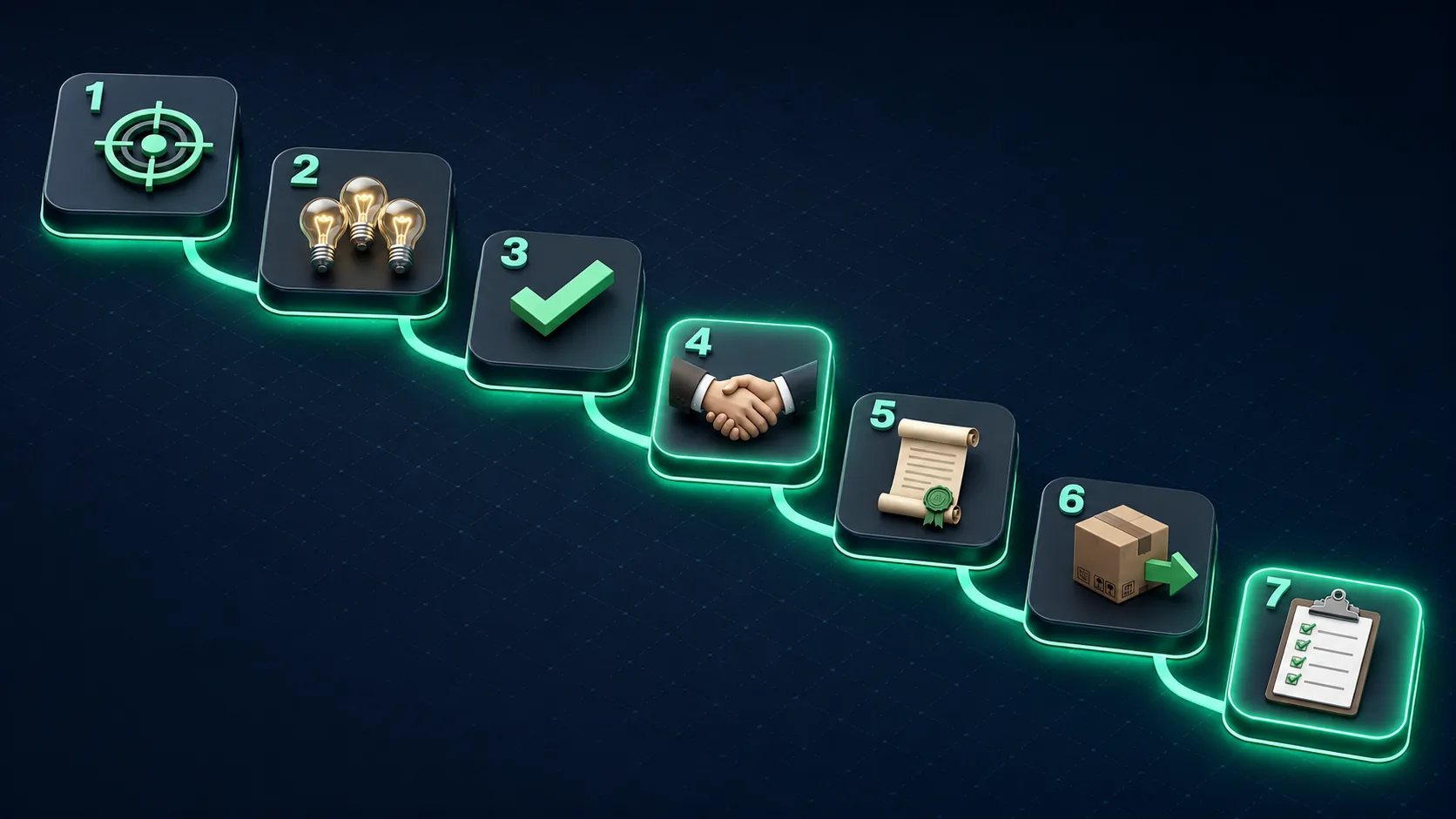
Beginners aren’t slow because they lack information. They’re slow because they treat each decision as if it must be perfect before moving on. Here’s the actual sequence and how long each decision should take. Set a timer.
-
Category and sub-category (5 days). Not “what to sell” yet. Just “which Amazon category am I going to be in.” Examples: Home & Kitchen, Pet Supplies, Sports & Outdoors. Pick by avoiding gated categories on day 1 (Health, Grocery, Beauty mostly gated for new sellers) and by personal interest if you can.
-
Three product candidates (7 days). Inside your chosen category, generate three product candidates that hit the criteria: $19-79 retail, $4-15 estimated landed cost, BSR (Best Sellers Rank) under 5,000 in main category, no patent flags, no brand-registered competitors dominating top 10.
-
Validate one of the three (5 days). Pick the strongest of three based on: monthly demand (use Helium 10 or Jungle Scout estimate), competition density (number of sellers with 100+ reviews), differentiation potential (can you add a feature, change a material, improve the design?). Kill the other two without regret.
-
Pick a supplier (7 days). Reach out to 8-12 Alibaba suppliers. Get quotes from 5. Sample the top 3. Pick 1.
-
LLC, UPC, trademark filing (14 days, parallel to step 4). File LLC in week 1 of this 14-day window so you have an EIN before placing the first PO. UPC purchase same week. Trademark filing can be week 2. It doesn’t block your launch since you can sell while it’s pending.
-
Place purchase order (1 day). Stop “researching.” Pay the deposit. The supplier will quote 30-45 days production lead time. The clock starts.
-
Set up Seller Central, listing, photography, PPC plan (runs in parallel with the 30-45 day production wait). This is “free” time you’ve already got because you’re waiting on the factory anyway. Use it.
Total elapsed time if you actually run this sequence: about 80 days. Plus 30-40 days for the inventory to arrive at Amazon’s warehouse. Plus 14-30 days of inbound check-in.
That’s 4-5 months from “I want to do FBA” to “live listing accepting orders,” if you don’t dawdle. We’ve seen sellers do it in 90 days flat (aggressive). We’ve seen sellers take 11 months (procrastinating on supplier selection). The difference is the willingness to move forward with imperfect information.
04The Beginner’s 90-Day Roadmap (Week-by-Week)
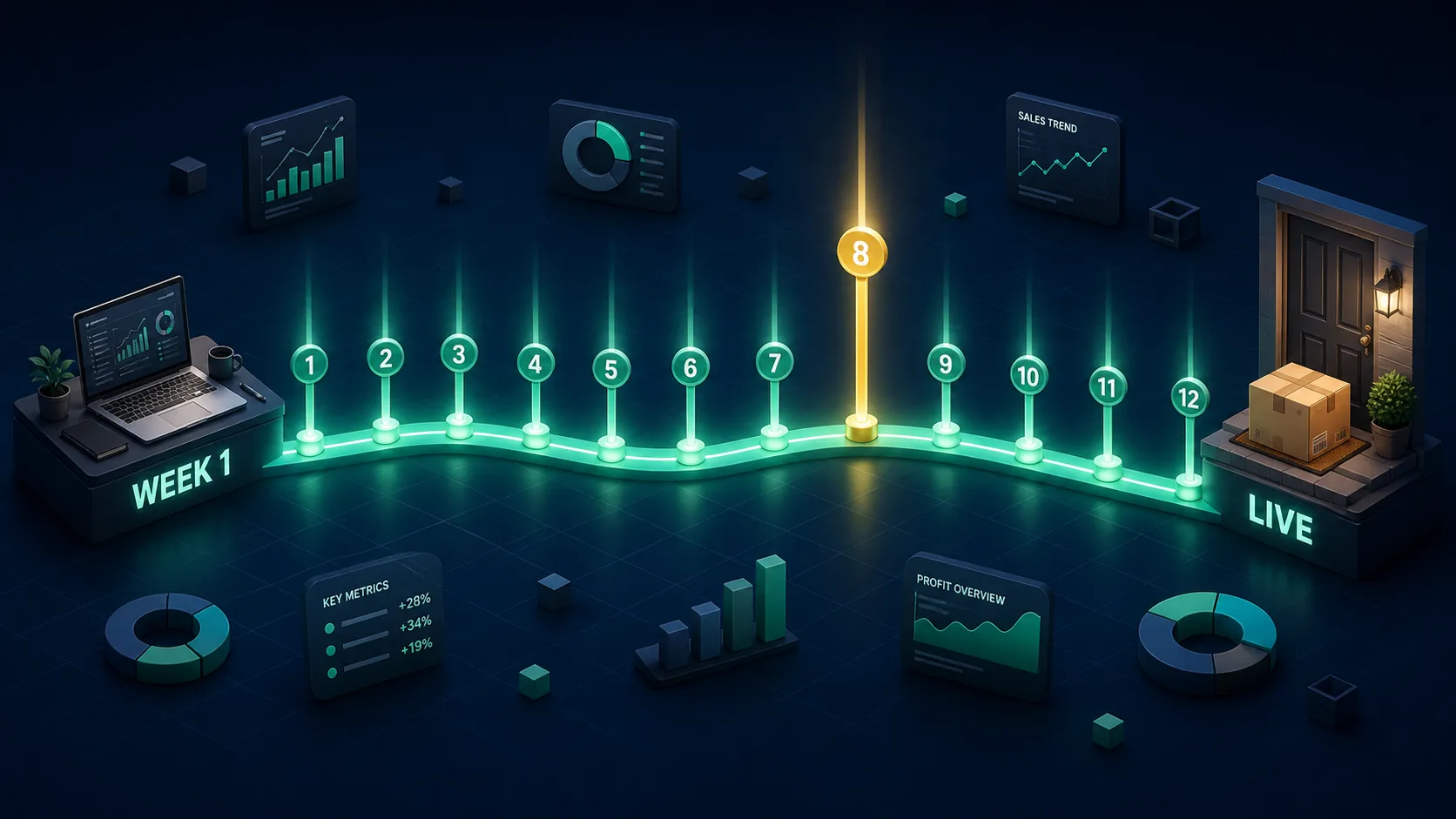
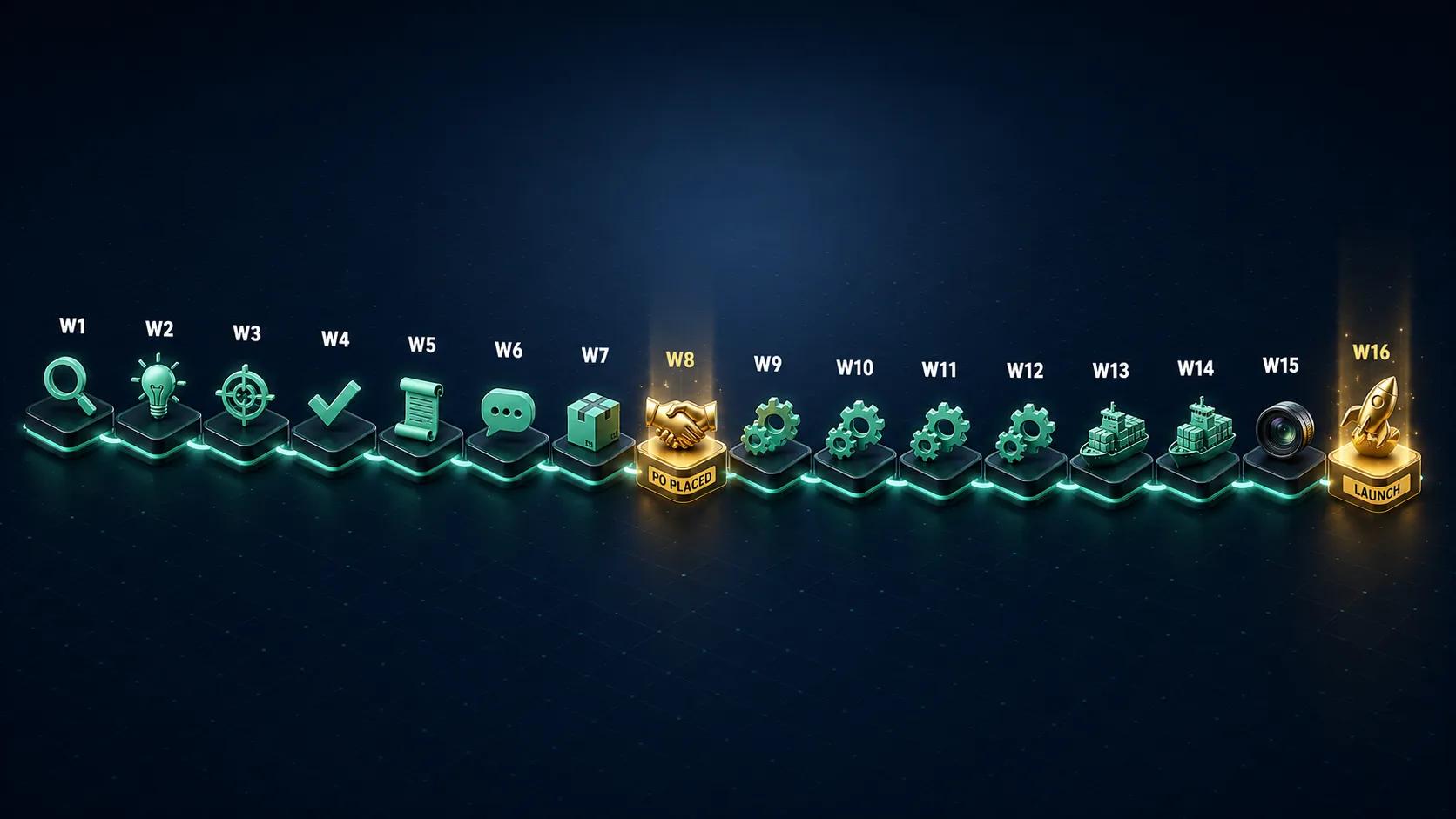
This is the version we hand new clients on day 1. Print it, tape it above your desk, follow it.
Week 1: Category lock. Pick your category. Open Helium 10 Black Box (free trial available) or Jungle Scout. Filter for: Home & Kitchen, Pet Supplies, Sports & Outdoors, Office, or Patio Lawn & Garden. Avoid Health & Beauty (gating risk), Grocery (perishable risk), Toys (Q4 seasonality), Books, and Apparel (returns nightmare).
Week 2: Generate 30 product ideas. Use Black Box / Opportunity Finder filters: BSR under 5,000, monthly revenue $5K-30K, fewer than 50 reviews on top 5 listings, no major brand-registered competitor. Skim 30 candidates. Shortlist 10.
Week 3: Narrow to 3, prepare to sample. From your 10 shortlisted, pick 3 based on: differentiation potential, sourcing accessibility (search Alibaba, see if there are 10+ suppliers offering similar items), and your gut. Don’t over-research. Move on.
Week 4: Validate the winner. For each of the 3, pull demand data, competition data, and a rough margin estimate (use Helium 10’s profitability calculator). Pick 1. The other 2 die.
Week 5: LLC + UPC + Brand Registry kickoff. File the LLC. Get the EIN. Buy the UPC from GS1 ($30 / year, multi-pack discounts available). Decide brand name. Initiate trademark filing (USPTO TEAS Plus form, $250 government fee).
Week 6: Supplier outreach. Send a templated message to 8-12 Alibaba suppliers offering products matching your spec. Track responses in a spreadsheet. Filter out the ones who don’t reply within 48 hours, who quote suspiciously low (red flag), or who can’t speak conversational English.
Week 7: Sample top 3 suppliers. Order one sample from each of your top 3. Each sample $50-150 plus DHL shipping. Total: $300-500 for this step. Worth every dollar. This is where you catch quality issues, packaging problems, and which supplier is actually responsive vs. hard to reach.
Week 8: Pick the supplier and place the PO. Compare samples in person. Confirm material, smell, weight, finish. Pick one supplier. Send PO with 30% deposit (typical industry standard). Production starts.
Week 9-12: Set up everything else. Seller Central account (if not done already). Photography brief (send a competitor screenshot to your photographer with notes on what to copy and what to improve). Listing copy draft (title, bullets, description, A+ Content layout). PPC plan draft. This 4-week window runs in parallel with production.
Week 13-14: Inventory in transit. Arrange freight forwarder. Sea freight from China to LA/NYC takes 25-35 days port-to-port plus 1 week customs. Total: 30-45 days. Use this time to finalize your launch PPC strategy.
Week 15-16: FBA inbound and first sale. Inventory arrives at Amazon’s warehouse. Check-in takes 3-7 days. Listing goes live. Run launch PPC. First organic sales typically appear week 17-18.
That’s the playbook. Print it. Tape it up. Resist the urge to “wait until the perfect product.” There is no perfect product, only products that are good enough to start, and the discipline to start.
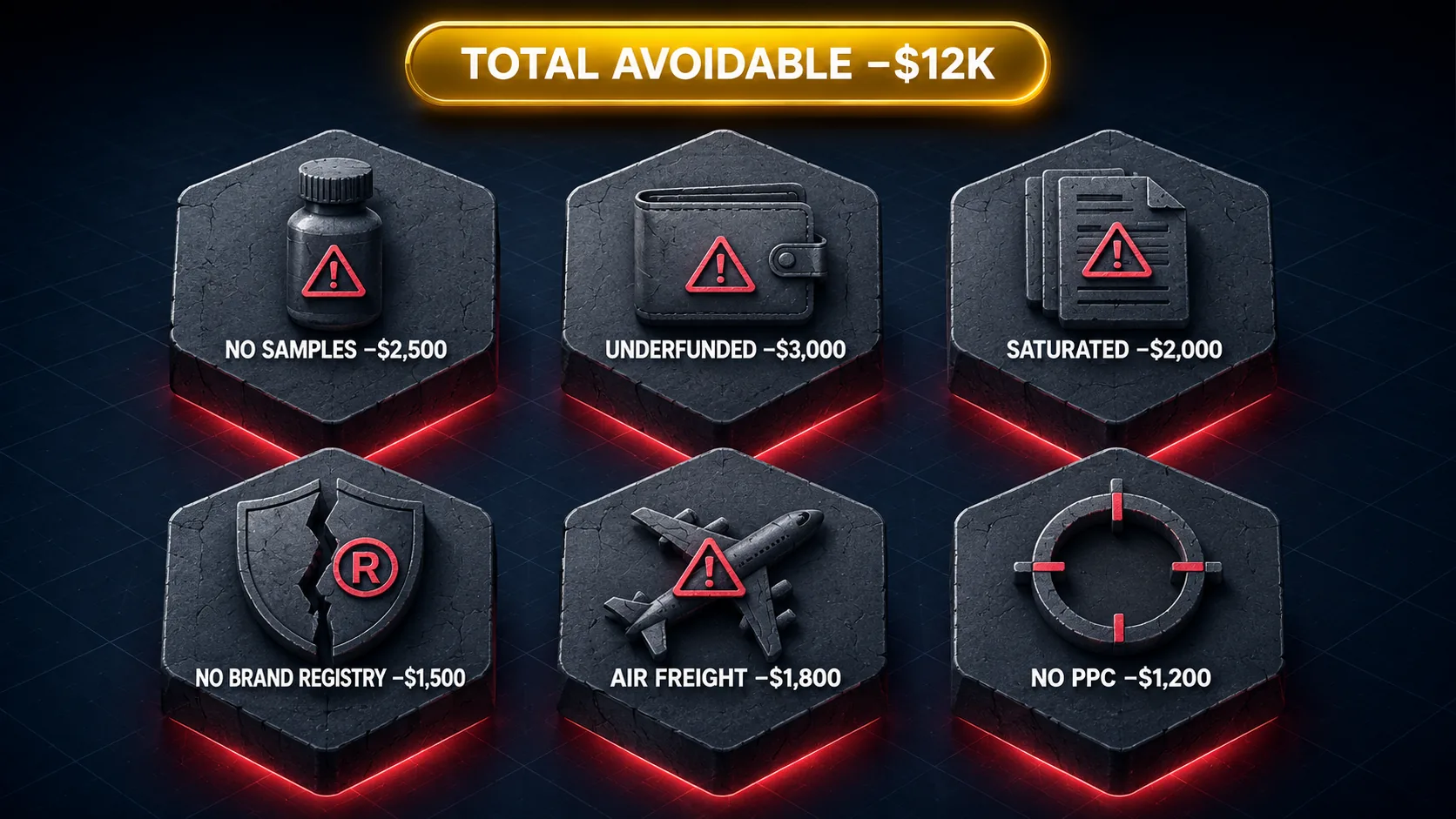
05Common Mistakes That Cost Beginners $5K+ in Year 1
We see the same handful of mistakes across nearly every failed launch. Each one is preventable with about 2 hours of upfront thinking.
Buying without sampling
Seller picks an Alibaba supplier based on price and "good photos," wires the deposit, waits. Product arrives at Amazon's warehouse with a defect: wrong color, broken stitching, missing component, or smelling strongly of chemicals. Amazon flags reviews. Listing dies. Prevention: spend $300 on samples. Always.
$3,000+
Underfunding the launch
Seller has $4,000 total. Spends $3,000 on inventory, $500 on photos, $500 on shipping. Has zero left for PPC. Listing sits at page 12, gets zero traffic, 18 months later the account closes with $3,000 of unsold inventory. Prevention: $5,000 minimum, $7,500 comfortable. Save until you do.
$4,000
Picking a saturated niche because "the demand is there"
New seller targets a product with 800+ established listings, 5+ Brand Registered competitors with 1,000+ reviews each, prices already driven down to $14-19 retail. The math doesn't work for a new entrant. Prevention: filter for top-10-listings with under 50 reviews. If the top 10 are all 1,000+ review fortresses, pick a different niche.
9-12 mo
Skipping Brand Registry
"I'll do it later." Months pass. Sales come in, but at 8-12% lower conversion than competitors with A+ Content. A hijacker shows up on the listing in month 4, undercuts price by 20%, no defense tools. Prevention: file the trademark in week 5. Filed-status alone gives you limited protections.
−8 to −12%
Air freighting the first order
"I want to launch faster." Pays $4 per unit instead of $1.20 for sea freight. On 500 units that's $1,400 burned for 3 weeks of speed. Prevention: plan sea freight from day 1. Build the wait into your timeline. $1,400 is better spent on PPC.
$1,400
Launching without a PPC plan
Seller goes live, runs auto campaigns at $1 default bid, wonders why nothing converts after 60 days. Prevention: 30/60/90 PPC plan in week 9-12 of the roadmap. Budget $20-50/day for the first 30 days. Aim for 25-40% ACOS in the first 60 days, accept higher early.
60 days
About half the suspended accounts we rescue trace to one of these six mistakes. Prevent the cause and you skip the rescue.
Speed beats research. Every week of "more thinking" you delay launch is a week of compounded learning lost. Real launches teach 10× faster than blog posts about launching. Lesson learned across 47 beginner client launches
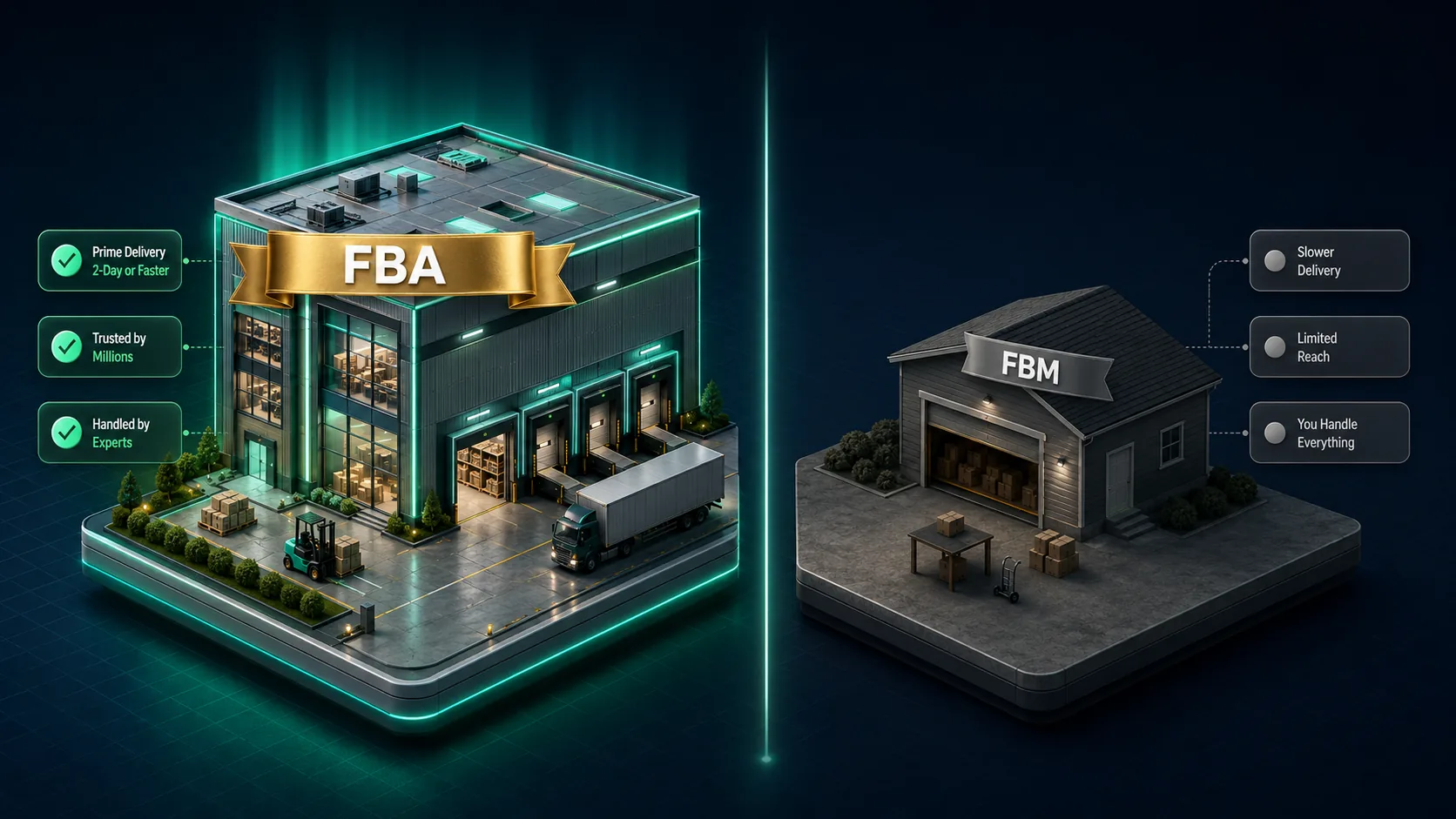
06FBA vs FBM vs Multi-Channel: Which Path First?
The honest answer for 90% of new sellers in 2026: pure FBA, US marketplace only.
| Metric | FBA (recommended) | FBM | Multi-channel |
|---|---|---|---|
| Conversion rate | +8 to +12% baseline | baseline | splits across channels |
| Prime badge | Yes, automatic | No | Amazon side only |
| Time to first sale | 14 to 16 weeks | 4 to 6 weeks | 12 to 20 weeks |
| Year-1 cash needed | $5,000 to $9,000 | $2,000 to $4,000 | $15,000+ |
| Buy Box priority | Algorithm favors FBA | No automatic priority | Per-channel rules differ |
| Operator load | Hands-off fulfillment | You pack every order | 3× the platforms, 3× the load |
| Suits beginners? | Yes, 90% of new sellers | Niche cases only | No, year 2 or 3 question |
FBM (Fulfillment by Merchant) makes sense when:
- Your product is oversized or hazmat (FBA fees would eat all margin)
- You have a 3PL relationship from a previous business
- You’re testing a product with 30-50 units before committing to FBA volume
- You’re selling handmade or short-run inventory where FBA inbound isn’t cost-effective
For everything else, FBA wins. The Prime badge alone is worth the per-unit fulfillment fee for products under 1 lb and under 12 inches, which is 70% of consumer goods.
Multi-channel (selling on Amazon plus Shopify, Walmart, eBay) makes sense in year 2-3 once you have a profitable product on Amazon and want to derisk platform dependency. It’s a distraction in year 1. New sellers who try to launch on three platforms simultaneously almost always fail on all three. Pick Amazon, win Amazon, then expand.
International marketplaces (Amazon UK, EU, Canada, Japan) make sense once you’ve cleared $300-500K/year in US revenue. Before that, the operational overhead of VAT registration, EU compliance, currency exchange, and translated listings outweighs the incremental revenue.
Path locked: pure US-only FBA, year 1. Add channels in year 2-3.
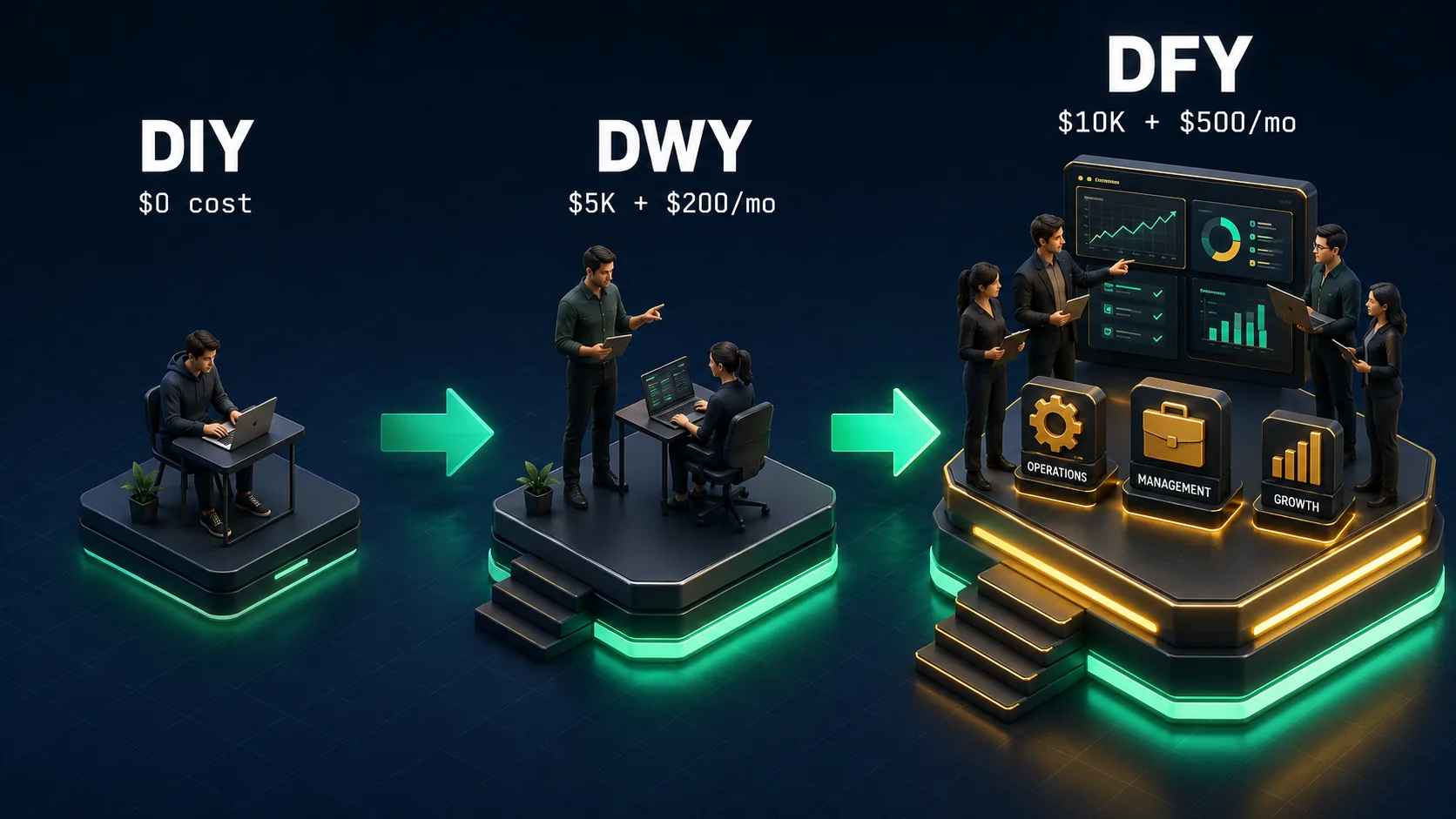
07When to Outsource (Done-With-You / Done-For-You) vs DIY
Most beginners should DIY their first product launch. You’ll make mistakes, but the lessons are foundational. You’ll never understand FBA economics until you’ve personally negotiated with a supplier, paid a deposit, and watched inventory arrive at the warehouse.
That said, outsourcing makes sense in three specific scenarios.
Scenario 1: capital but no time. Senior W-2 employees with $50K-200K savings and a full-time job often hit DIY at week 3 (the supplier-outreach step) and stall there. They have the cash to launch but no bandwidth to manage Alibaba conversations during business hours. For these sellers, our Product Research service handles weeks 1-4 of the roadmap (category, products, validation, supplier shortlist) for $1,500 flat. The seller still owns the brand and runs the business. They just skip the most time-intensive research phase.
Scenario 2: you’ve launched once, lost money, and want to do it right this time. Failed first launches usually trace to one of two things: bad product pick or bad supplier pick. A second-time seller with $7,500-10,000 willing to pay for done-with-you launch support reduces the failure rate to about 30% (vs. 70-80% for an unguided second-time launch). Our DWY tier ($5,000 onboarding + $200-497/month) covers the launch end-to-end with monthly strategy calls.
Scenario 3: you have $50K+ and want to skip the operator role entirely. Investors, semi-passive income seekers, or established offline business owners often want Amazon as a portfolio play, not a hobby. For them, DFY ($10,000 onboarding + $500-1,000/month) makes sense. Our team runs product research, sourcing, listing, PPC, and brand defense; the client reviews monthly P&L. Capacity is limited to 10-20 active clients, and we hire to scale beyond that, which we’re doing now.
For everyone else: do it yourself. The first launch is the most valuable education in Amazon you’ll ever pay for, and you pay it in mistakes rather than fees.
Frequently Asked Questions
How much money do I really need to start Amazon FBA in 2026?
A realistic minimum is $5,000 with comfortable runway at $7,500-9,000. This covers initial inventory ($2,500), samples ($300), branding ($300), LLC and trademark ($600), UPC ($30), inspection ($250), shipping ($800), photography ($400), launch PPC ($1,500), and tools ($150 first month). Anyone selling “start FBA with $500” is selling you something other than truth.
Can I sell on Amazon FBA from outside the US?
Yes. Amazon allows sellers from over 100 countries to sell in the US marketplace. You’ll need a US bank account (Payoneer or Wise work), a US tax ID (you can apply for an ITIN as a non-US person), and an LLC or sole proprietorship. We’re based in Karachi, Pakistan, and have run US Amazon stores for clients since 2020. International setup is normal and well-documented.
How long does it take to make money on Amazon FBA?
From “I want to start” to “first sale” is typically 4-5 months if you follow a clear roadmap. From “first sale” to “consistent profit” is another 3-6 months. Most successful sellers we work with hit break-even by month 8-10 and meaningful profit by month 12-15. Anyone promising “$10K/month in 90 days” is showing you the exception, not the rule.
Is Amazon FBA still worth it in 2026 with all the saturation?
Yes, but only if you avoid saturated niches. Amazon’s catalog has tightened, fees are up 15-20% vs. 2022, and competition in the obvious categories (phone accessories, basic kitchen gadgets, generic supplements) is brutal. But sub-niches with under-50-review top-10 listings still exist in every category. Finding them takes 2-3 weeks of disciplined research, not a tool subscription.
Do I need a brand registered trademark to sell on Amazon?
Not technically. You can sell as a generic seller without Brand Registry. But you’ll forfeit A+ Content, Sponsored Brands ads, brand analytics, and listing protection. Conversion rate runs 15-25% lower without these tools across our managed accounts. File the trademark in week 5 of your launch sequence. The $250 USPTO fee plus the 6-9 month wait is one of the highest-ROI dollars you’ll spend.
Should I start with FBA or FBM as a beginner?
FBA. The Prime badge, hands-off fulfillment, and Buy Box priority are worth the per-unit fees for 90% of products. FBM only makes sense for oversized, hazmat, or short-run inventory. Don’t over-think this. Pick FBA and move on.
The Bottom Line
Amazon FBA in 2026 is harder than it was in 2018, but the playbook is more proven than it was in 2018. The sellers who win aren’t smarter. They’re faster decision-makers who refuse to over-research. Pick a category in 5 days. Validate three products in 7 days. Sample suppliers in 7 days. Place the PO. Set up everything else during the production wait. Total: 90 days from start to live listing.
The single most valuable thing a beginner can do is stop reading “complete guides” (including this one) and start the week-1 step today. The information you need is 10% of what you think. The discipline to act on incomplete information is 90%.
We currently manage Amazon stores generating $200,000/month for paying clients out of our Karachi office. Half a decade of running other people’s launches taught us the same lesson over and over: speed beats research. Start.