
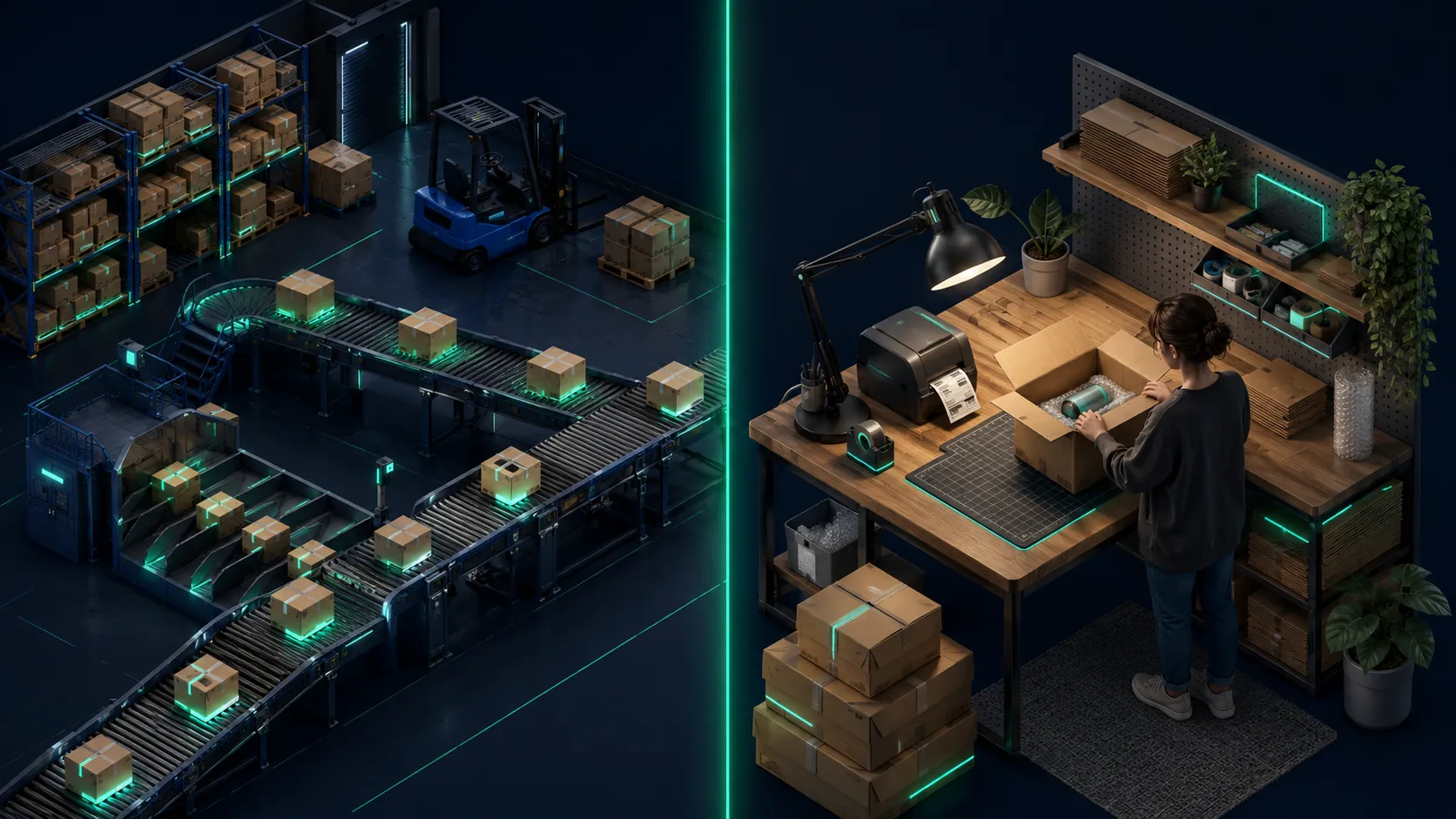
Two clients of ours launched the same product in the same month last year. One picked FBA, one picked FBM. The FBA seller hit 80 units a day at month four with a $42 average ticket. The FBM seller capped at 22 units a day with the same ticket, same listing copy, same PPC budget. The difference was the Prime badge, the Buy Box algorithm preference, and the fact that buyers trust two-day shipping more than they trust a “ships in 5-7 days” disclaimer. That is the FBA vs FBM tradeoff in one paragraph. The longer answer, including when FBM actually wins, is below.
01What FBA actually does (and what FBM actually does)
FBA stands for Fulfillment by Amazon. You ship your inventory to Amazon’s warehouses. Amazon stores it, picks it when an order comes in, packs the box, ships it to the buyer, handles returns, handles customer service emails, and refunds disputes on your behalf. You set the price and own the listing. Everything between “buyer clicks Buy Now” and “package lands on doorstep” runs on Amazon’s infrastructure.
FBM stands for Fulfillment by Merchant. The listing is still on Amazon. The marketplace is still Amazon. But the fulfillment runs on you. You hold the inventory in your own space, you box and label every order, you book the shipping label through Amazon Seller Central or a third-party app, you handle returns to your address, and you respond to customer messages within Amazon’s 24-hour SLA or your seller metrics get hit.
Two things confuse beginners about this split. First, FBM is not the same as drop-shipping. You still own real inventory with FBM. The only difference from FBA is who packs the box. Drop-shipping is a separate model, usually disallowed by Amazon’s policy unless the supplier ships in your branded packaging.
Second, the choice is not all-or-nothing. You can run FBA for one product and FBM for another, on the same Seller Central account, no problem. We have managed accounts where the parent SKU runs FBA, the bulk variation runs FBM, and the seasonal accessory runs FBM only at Q4 when FBA storage fees triple. The choice is per-SKU, not per-seller.
What you give up with FBM, beyond the obvious labor of packing boxes, is the Prime badge. Without Prime, your listing competes against listings that do have Prime, on the same product page, for the same Buy Box. Amazon’s algorithm gives Prime listings preference roughly 80% of the time when price and reviews are close. That is the single biggest reason most beginners go FBA.
What you give up with FBA is cash flexibility. You ship 500 units to Amazon. The first 30 days you may not sell 50. You are paying monthly storage on the other 450 units while waiting for the algorithm to find you organic traffic. FBM has no per-unit storage fee until your inventory ages past 365 days, because the inventory is sitting in your own warehouse or apartment.

02The real cost math, side by side
Most “FBA vs FBM” comparison articles online list seven generic pros and cons. They do not show you the spreadsheet. The spreadsheet is what matters, because the answer depends on your product’s size, retail price, and weekly sales velocity.
Here is the math we run for every new client before recommending one or the other. Numbers below are 2026 rates pulled from Amazon’s published fee schedule plus our own portfolio of currently active managed accounts.
| Cost line item | FBA | FBM |
|---|---|---|
| Per-unit fulfillment fee | $3.86 to $25+ depending on size tier | $0 (you pack) |
| Monthly storage fee per cubic foot | $0.87 Jan-Sep, $2.40 Oct-Dec | $0 (your space) |
| Long-term storage (after 365 days) | $6.90/cu ft additional | $0 |
| Inbound shipping (factory to FC) | $0.50 to $2 per unit on sea freight | Same factory cost, no FC leg |
| Outbound shipping cost | Built into fulfillment fee | $3.50 to $9 per order at USPS Ground |
| Returns handling | $0 (Amazon eats it) | ~3% of orders, you process |
| Time per order packed | 0 minutes | 3 to 5 minutes per order |
| Year-1 cash needed for 1 SKU | $5,000 to $9,000 | $2,000 to $4,000 |
| Time to first organic sale | 14 to 16 weeks | 4 to 6 weeks |
| Prime badge eligibility | Yes, automatic | No (or paid Seller-Fulfilled Prime, rare) |
| Buy Box algorithm priority | ~80% favored over equal FBM offer | Loses ~80% of the time |
| Avg conversion rate vs same listing without Prime | +8 to +12% | Baseline |
Two numbers do most of the work in this table. The +10% conversion rate lift from Prime, and the $3.86-$25 per-unit fee. If you are selling a $30 product, $3.86 is 13% of revenue. If you are selling a $9 product, $3.86 is 43% of revenue and the math collapses. That is why FBA suits products in the $19-79 retail range almost exclusively, and why low-priced commodity sellers usually run FBM.
The cash gap matters too. We have watched dozens of beginners run out of money in month 6 of an FBA launch because they spent $5K on inventory and $1K on PPC and had nothing left for restock when sales actually picked up. FBM at $2-4K year 1 leaves you cash buffer to actually run the business. If your total bankroll is under $5,000, FBM is not a downgrade, it is the only realistic path.
03Where Prime really earns its keep
We pulled conversion data across 14 managed accounts where the same SKU ran FBA for three months, then switched to FBM for three months due to a supplier delay, then switched back. The conversion rate on the FBA side averaged 11.4%. The conversion rate during the FBM window averaged 8.9%. Same listing, same price, same images, same PPC. Prime alone moved 2.5 percentage points of conversion, on a sample with enough volume to call it real.
That 2.5 points compounds in two places. First, every percentage point of conversion makes your PPC cheaper because you need fewer clicks per sale. Second, Amazon’s algorithm rewards listings with higher conversion rates by surfacing them in more searches. Higher conversion creates a positive feedback loop in your organic ranking that is hard to replicate any other way.
This is the part beginners underestimate. FBA is not just convenience. It is a trust signal that the algorithm bakes into ranking. Without Prime you are paying the algorithm tax in lost organic visibility for the life of the listing.

04When FBA is the right answer
For most beginners building a private-label brand from scratch, FBA wins by default. Specifically, FBA is the right call when all four of these are true:
-
Your product is small standard or large standard size (under 18 inches longest side, under 14 inches median side, under 8 inches shortest side, under 20 lbs). This keeps fulfillment fees in the $3.86 to $7 range. Oversize fees climb fast. A 24x18 inch product can hit $25+ per unit, which kills most margins.
-
Your retail price is $19 to $79. Below $19, fees eat too much. Above $79, you should still consider FBA but the math gets more flexible because the percentage drops. We have run FBA on $149 SKUs profitably. We have never run FBA on a $9 SKU profitably.
-
You expect 5+ units per day average sales by month 6. Below this, monthly storage fees compound on inventory that is not moving. We use 5/day as a rough velocity floor below which FBA stops paying off.
-
You have $5,000-9,000 in actual launch capital. Not “I can borrow it from my brother in three months.” Cash on hand. FBA front-loads the inventory cost, the PPC cost, and the wait time. Underfunded FBA launches are the single most common death pattern we see.
If those four are true, FBA wins on margin, on time, and on what we call “operator load,” meaning how much of your day this business eats. FBA gives you back the 2-3 hours per day you would otherwise spend packing boxes, dropping off at the post office, and answering customer messages. For a side-hustle brand running alongside a day job, that recovered time is the actual product.
The 5-units-per-day velocity threshold is conservative. We have seen FBA stay profitable down to 2 units per day on premium-priced ($60+) low-storage-volume SKUs. The point is not the exact number, it is that FBA's monthly storage fee per cubic foot punishes slow movers, and you should model your worst-case velocity before committing to a 500-unit order.

05When FBM beats FBA
There are four scenarios where FBM is genuinely the better choice, not just a backup plan. We use FBM ourselves in all four when client conditions match.
Heavy or oversized SKU
5+ lbs OR 18+ inches
Anything over 5 lbs or 18 inches longest side gets pushed into FBA's oversize tier. Per-unit fees jump from $5 to $15-25+. Monthly storage on a 24-inch product is 2-3x a small-standard product. We have seen $40 wall art lose money on FBA and clear 30% margin on FBM, same listing, same traffic.
Low-margin commodity
$9-19 retail, mass-market
Phone cables, basic kitchen tools, generic accessories. FBA fees on these eat 35-45% of revenue. FBM keeps cost-per-order under $5 even after USPS Ground shipping, leaving 25-30% margin. The Prime conversion lift cannot beat the fee math when fees are this large a percentage of price.
Premium white-glove brand
Hand-finished or custom
If your brand differentiator is the unboxing experience (custom tissue paper, handwritten note, branded inserts), Amazon's FBA prep restrictions kill that. FBM lets you control the package end-to-end. Smaller premium brands who outcompete on perceived quality often run FBM intentionally.
The fourth scenario is launch testing. If you are not sure whether your product idea has demand, and your bankroll is $3,000 total, run FBM with 50-100 units first. You will know within 6 weeks whether the listing converts. If it does, switch to FBA, place a 500-unit order, and scale. If it does not, you have lost $1,500 testing instead of $5,000 committing.
About 30% of the SKUs in our managed portfolio run FBM permanently. Another 15% started FBM as a launch test, then switched to FBA after demand was confirmed. The remaining 55% have always been FBA. The split tracks roughly to product price and size, not to seller experience or capital available.
06Hybrid: running FBA and FBM at once
Hybrid means using both fulfillment methods on the same Seller Central account, sometimes on the same SKU. There are three legitimate hybrid plays.
The first is bulk-variation hybrid. Your main SKU is a 6-pack at $39 retail, runs FBA. You also offer a 24-pack bulk variation at $129 retail. The 24-pack is too heavy and bulky for FBA’s standard tier (oversize fees would crush it), so you list the bulk variation as FBM. Same Seller Central listing page, two child ASINs, two fulfillment methods. Customers see both options. Amazon’s algorithm handles the routing.
The second is seasonal hybrid. Your main SKU is FBA year-round. In Q4 (October to December) Amazon’s storage fees triple to $2.40 per cubic foot. If you are sitting on 800 units of slow Q4 movers, you can pull excess inventory out of FBA via a removal order, store it yourself, and run FBM on the slow units while keeping the rest in FBA. We did this for a Halloween-themed pet product client in 2024 and saved them $1,400 in Q4 storage fees on dead stock.
The third is launch-test hybrid. New SKUs go up FBM first with 100 units to validate listing conversion. Once the listing converts above 8% with 25+ reviews, you place the larger PO and switch to FBA. This avoids the worst FBA failure mode, which is sending 1,000 units to Amazon’s warehouse for a product that turns out not to convert.
The biggest hybrid mistake we see is splitting inventory between FBA and FBM at the same time, on the same SKU, without realizing Amazon's Buy Box algorithm picks one or the other based on price and shipping speed. If your FBA price is $29 with 2-day Prime and your FBM price is $26 with 5-day shipping, the Buy Box flips between them and your conversion rate stutters. Pick one method per SKU per timeframe, or price the FBM offer high enough that it never wins the Buy Box and just exists as a backup for buyers who want it.

07The 5 mistakes beginners make picking FBA vs FBM
Across 47 beginner client launches since 2022, the same five mistakes show up over and over. Each one is preventable if you sit with the math for 30 minutes before placing the supplier PO.
Picking FBA without modeling the storage fee curve
Beginner orders 1,000 units, ships them all to Amazon, and then sells 80 in the first 60 days. The other 920 sit in FBA accumulating storage fees through Q4, when storage costs jump to $2.40 per cubic foot. By month 9, storage has eaten $800 of margin on a launch that has not yet broken even. Prevention: model storage fees against your worst-case 90-day velocity before placing the order. If you cannot afford to sit on 600 unsold units for 6 months, do not order 1,000.
$600-1,400
Picking FBM with no plan for handling the volume
Beginner picks FBM to save money on fulfillment fees. Listing takes off in week 6. They are now packing 30 orders per day from their kitchen, the post office trip is eating 2 hours daily, and customer service messages are stacking up past Amazon's 24-hour SLA. Seller metrics drop, account gets a warning. Prevention: if you go FBM, line up a 3PL contract or a packing helper before you need them. The breakpoint is usually 15-20 orders per day.
10-14 hr/wk
Pricing FBM the same as FBA listings
Beginner sees competitor selling at $29 on FBA, lists their FBM offer at $29 too. Buyer compares the two, sees Prime 2-day shipping on competitor vs 5-day shipping on the beginner, picks competitor. Beginner's listing dies. Prevention: when running FBM against FBA competitors, you need to price 8-15% under to offset the Prime handicap, OR offer something the competitor does not (extended warranty, bundled accessory, premium packaging).
−40 to −60%
Forgetting Q4 storage fees exist
FBA seller is profitable Jan-Sep at $0.87 per cubic foot. Q4 hits, fees jump to $2.40, and a slow holiday SKU that was breaking even now bleeds $200 per month. Beginner finds out via the December settlement, weeks too late to remove inventory. Prevention: mark your calendar. October 1 is the fee-jump date every year. If you have inventory of a slow seller above 60 days of cover, file a removal order in mid-September and run FBM through Q4.
$300-900
Using FBM as "the cheap option" for an oversize product
Beginner picks a 24-inch product, realizes FBA oversize fees would be $20+ per unit, defaults to FBM. They ship 50 units. The freight cost from their warehouse to East Coast buyers averages $11 per order. After Amazon's referral fee and packaging cost, margin is 4%. Listing limps along for 8 months without ever scaling. Prevention: oversize products usually do not work for new sellers period. Pick a small-standard or large-standard product first. Oversize is a year-2 conversation.
4% net
About a third of the suspended-account rescues we run trace back to mistake #2 specifically. Beginner picks FBM, listing scales faster than expected, customer service SLAs slip, account flagged for late shipments, account gets the warning, beginner panics and switches to FBA mid-launch, lose 3 weeks of momentum during the transition. Plan the operations side before you pick FBM.
The fulfillment decision is operational first, financial second. Pick FBA if you want time. Pick FBM if you want cash. Pick hybrid if you have already done it once and know which way each SKU bends. What we tell every beginner client in the first onboarding call
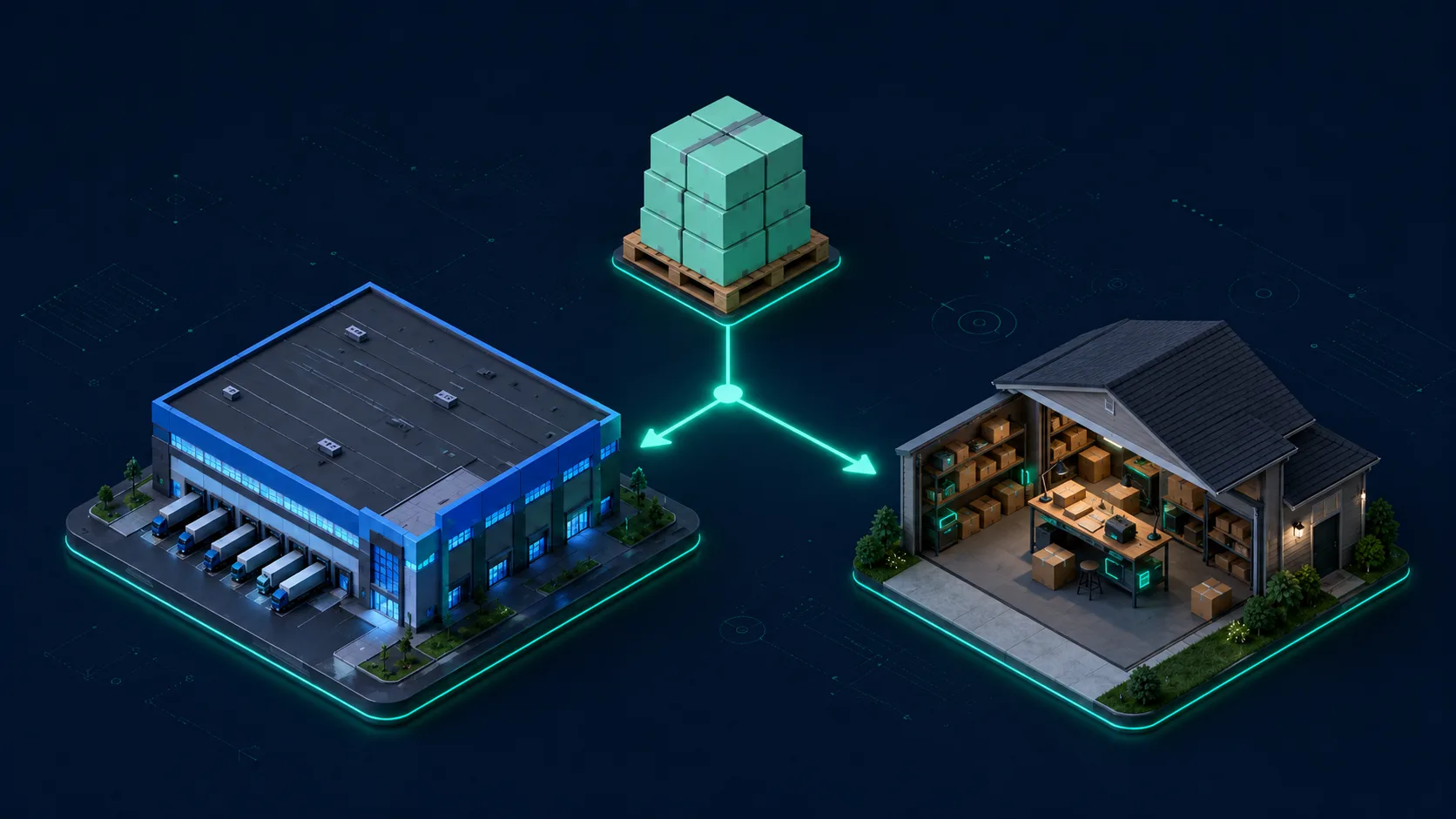
08The decision tree we use with new clients
We have a 7-question decision tree we run with every new client in the first onboarding call. It usually takes 10 minutes. Run it on yourself. The answer falls out the bottom.
Question 1: Is your retail price between $19 and $79? If yes, FBA candidate. If no (under $19 or over $79), FBM candidate, with caveats above.
Question 2: Is your product under 18 inches longest side and under 5 lbs? If yes, FBA stays viable. If no, FBM is more likely.
Question 3: Do you have $5,000+ in actual cash on hand for the launch? If yes, FBA stays viable. If no (under $5K), FBM is the realistic path. Try not to lie to yourself on this one. “I have $4K and I can save another $2K in three months” is not $5K cash on hand. Plan with the money you actually have.
Question 4: Do you expect to be selling 5+ units per day by month 6? If yes, FBA storage math works. If no (under 5/day or unsure), launch FBM, validate, switch to FBA later.
Question 5: Will you be running this alongside a full-time job? If yes, FBA almost certainly wins (operator-load issue). FBM at 30 orders per day eats 12 hours per week of your evenings. If no (full-time on this business), FBM is fine for the right SKU.
Question 6: Do you have a 3PL contract or packing helper lined up? If yes, FBM scaling risk drops. If no, default to FBA or cap FBM at SKUs you expect to do under 15 orders per day.
Question 7: Are you planning to sell across multiple channels (Walmart, Shopify, eBay)? If yes, FBM (or hybrid with Multi-Channel Fulfillment) is more flexible. If no (Amazon-only), FBA is simpler.
If the first four questions all say FBA, run FBA. If the first four say FBM, run FBM. If they split, the answer is usually launch FBM, validate the listing, then switch to FBA at the 50-review mark or the $10K monthly revenue mark, whichever comes first.
The mistake beginners make is treating this as a permanent decision. It is not. You can change fulfillment methods on the same SKU in 2-3 weeks (file a removal order from FBA, get inventory back, relist as FBM, or vice versa). The decision is reversible. The cost of being wrong for 6 months is real, though, so spend the 30 minutes modeling.

09Frequently asked questions
Is FBA worth it for a $15 product?
Usually no. FBA fees on a $15 product run $4-6 per unit, which is 27-40% of revenue before product cost. After supplier cost and PPC, margin lands at 5-12%. That is a working margin only if you are doing 50+ units per day, and most $15 products do not hit that velocity outside of consumables. For $15 retail, run FBM or skip the product entirely and pick something at $25+.
Can I switch from FBM to FBA later?
Yes. This is one of the more common operator moves. Validate the listing on FBM with 50-100 units. Once you have 25-50 reviews and conversion is above 8%, place a 500-unit factory order and ship the new units directly to Amazon’s FBA warehouses. Keep the FBM offer alive at a higher price during the transition (week 1-2) so you do not stock out while the FBA inventory is being received and checked in.
Does Amazon penalize FBM listings?
Not directly, but the algorithm prefers FBA listings for Buy Box assignment, and Prime members filter out non-Prime listings (about 65% of Amazon shoppers have Prime in 2026). So your FBM listing is structurally invisible to a chunk of buyers, even with a perfect listing. That is not a “penalty,” it is a structural disadvantage that compounds over time.
How much does FBM actually cost per order?
Domestic USPS Ground for a small-standard package (under 1 lb, under 12 inches) runs $3.50-4.50 with Amazon’s Seller Fulfilled rates. Add $0.50-1 for packaging materials. Add 3-5 minutes of your time for picking, packing, and labeling. If your time is worth $30/hour to you, that is another $1.50-2.50 of opportunity cost per order. Total real cost: $5.50-8 per FBM order. Compare to FBA fulfillment fees of $3.86-7 with zero of your time.
Can I run Seller Fulfilled Prime on FBM?
Technically yes, practically rarely. Seller Fulfilled Prime requires you to ship 99% of orders within 1 business day, deliver 99% in 2 days nationwide, and maintain it through a 30-day trial period. Most beginners cannot hit those metrics from a home setup. Amazon paused new SFP enrollment in 2023 and reopened it in 2024 with stricter requirements. If you can hit it, SFP gives you Prime visibility on FBM, which is the best of both worlds. If you are running this from your apartment, do not plan on SFP working for you in year 1.
What if my product is gated for FBA (heavy, hazmat, etc)?
FBA has restrictions on hazmat (lithium batteries above certain capacity, aerosols, flammables, etc), oversize-special items, and a few category-specific restrictions (some grocery, some adult products). If your product is gated for FBA, FBM is your only option. Some sellers run FBA-disqualified products with a 3PL that handles hazmat compliance, which gets you closer to FBA-equivalent shipping speeds without using Amazon’s warehouses.
Should my second product use the same fulfillment as my first?
Not necessarily. The fulfillment decision is per-SKU, per-product-economics. Your first product might be FBA at $29 retail. Your second product might be FBM at $79 retail in a different category. Run the same 7-question decision tree on each product independently. We have clients running FBA on 4 SKUs and FBM on 3 SKUs in the same Seller Central account, no penalty.
How do FBA fees change in 2026?
Amazon raised standard FBA fulfillment fees by an average 4.6% in January 2026, with the largest increases on small-standard size tier (jumped from $3.65 to $3.86). Storage fees stayed flat at $0.87 / $2.40 per cubic foot. Inbound placement service fees (the new optional fee for letting Amazon distribute your inventory across multiple FCs) are now opt-in, $0.27-1.34 per unit depending on size. Most beginners should opt in for the +30% sales lift Amazon claims (we measured +18% across our portfolio, still worth it).